Your agents share a repo, not a brain.
Teamplane gives every teammate and every agent a signed mandate, a lease on what it touches, a permissioned memory it may read, and an auditable merge gate.
$ teamplane playground --open
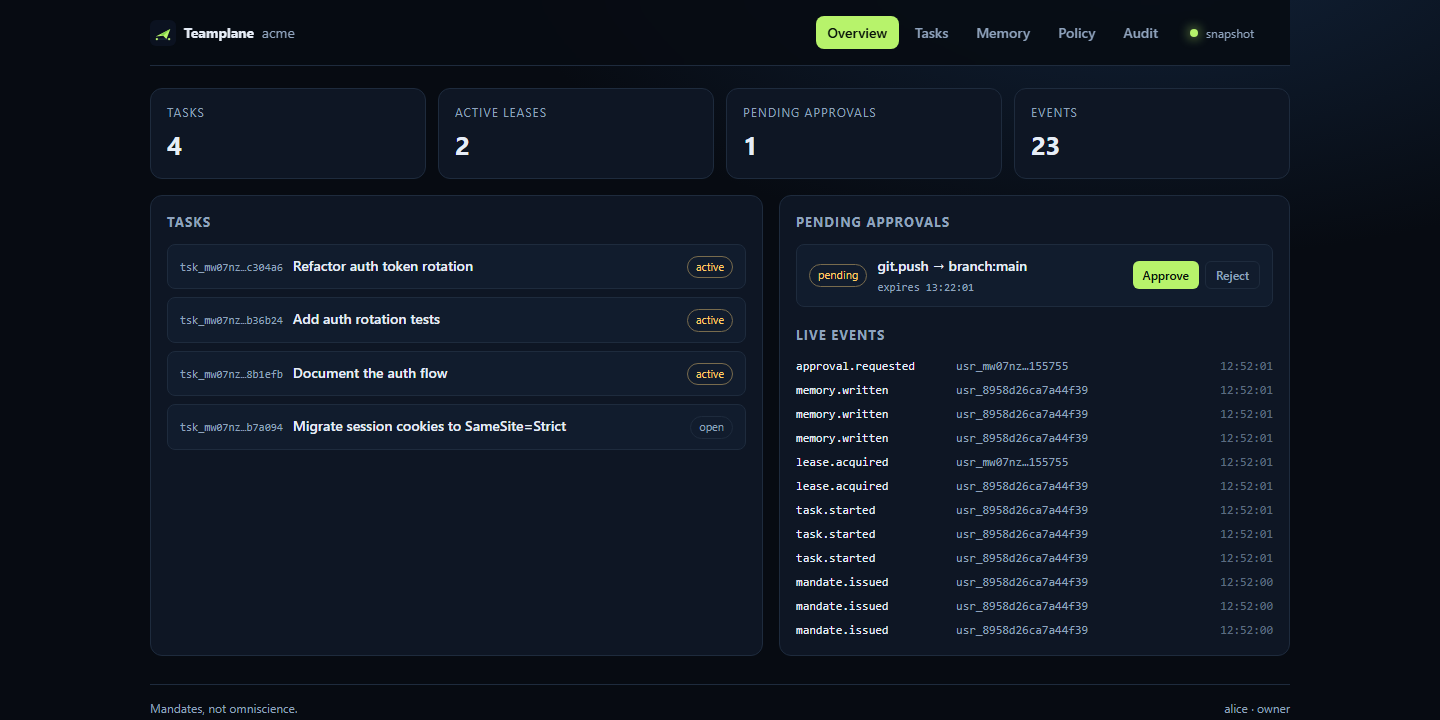
Three mechanisms, no supervisor
Every decision is reproducible from the event log.
Authority is a signature
Ed25519 capabilities bound to one principal and one task. Derivation only narrows. Verification works offline; revocation is an event.
Policy is a pure function
Deny > ask > allow, default deny, plus typed leases with fencing tokens. No model is consulted at decision time.
Coordinate without transcripts
Typed events and curated memory fragments with provenance and ACLs. The team sees conclusions, not conversations.
Sixty seconds to a team
# build and start a seeded playground
npm install && npm run build && npm link
teamplane playground --open

# or run the executable proof
npm run demo

# verify the audit chain
teamplane audit verify
What the demo proves
- carol cannot write outside her mandate
- bob cannot take a lease alice holds
- force push returns
askuntil an owner approves, once - a failing verification command blocks a clean-looking merge
- the hash-chained audit log verifies
One control plane, any MCP agent
DeepSeek Harness, Claude Code, Cursor and Codex connect over MCP — stdio or Streamable HTTP.
The ten tp_* tools cover leases, memory, approvals, events and submit.
“The model keeps the interesting job — planning, coding, judgement — and loses the two jobs it is worst at: being an authority and being a lock.” docs/design-notes.md
# DSH profile patch
- id: mcp-teamplane
  name: '@deepseek-ai/dsh-mcp-client'
  config:
    serverName: teamplane
    transport: stdio
    command: teamplane
    args: ['mcp']
    env:
      TEAMPLANE_URL: http://127.0.0.1:7317
      TEAMPLANE_TOKEN: !!js process.env.TEAMPLANE_TOKEN
Honest about the boundary
- Worktree writes need the experimental host guard, not just MCP
- Textual conflicts are verified; semantic breakage needs your tests
- Single node, one writer, O(n) replay in v0.1
- Per-fragment ACLs do not prevent inference from combining fragments
Read the argument
The design notes cite the prior art it builds on — Collaborative Memory, MERGEGYM, ScopeGate, DelegateGuard and DeepSeek Harness's Super-agent — and state what would falsify the design.